Why Not Just
RO / UV / UF / Softener
What’s the difference?
Best Water Purifier For You
Check out the best water purifiers based on your needs & water quality.
Why It Matters
Different water purification technologies tackle different impurities. Understanding how RO, UV, and UF systems work helps you choose the right purifier based on your water’s TDS level and source.
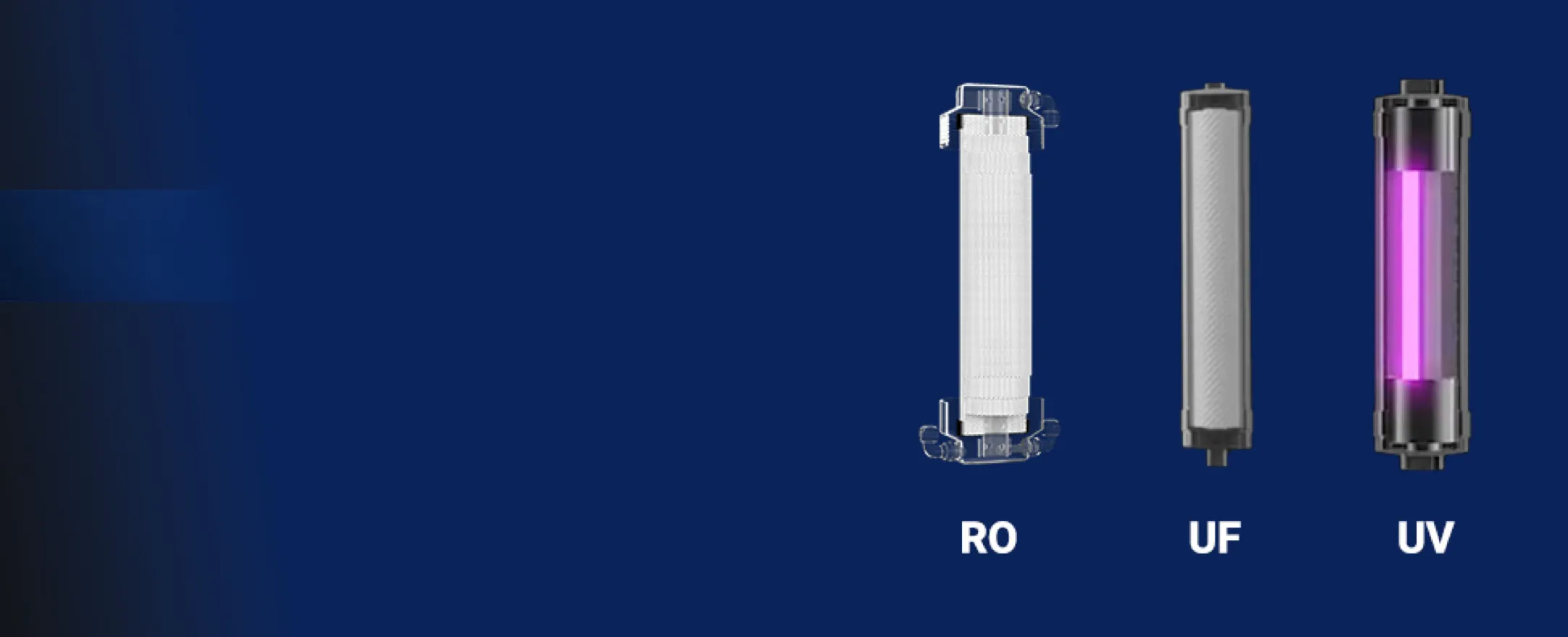
RO (Reverse Osmosis) Purifier
RO uses a semi-permeable membrane to remove dissolved salts, heavy metals, and chemicals. It’s ideal for high-TDS water (above 300 ppm), commonly found in borewells or hard water areas. It delivers soft, great-tasting water but requires electricity and produces some reject water.
Best for : High TDS / Hard water areas
Removes : Dissolved solids, metals, salts, microbes
UV (Ultraviolet) Purifier
UV purification uses UV light to kill harmful microorganisms without adding chemicals. It doesn’t reduce TDS or remove dissolved impurities, making it ideal for low-TDS municipal water that may contain bacteria or viruses.
Best for : Low TDS water (below 300 ppm)
Removes : Microbes only
UF (Ultra Filtration) Purifier
UF uses a fine membrane to block bacteria and suspended impurities. It works without electricity and doesn’t reduce TDS. Perfect for areas with low TDS but visible particles in water.
Best for : Low TDS / Normal tap water
Removes : Bacteria, dirt, visible impurities
| Feature | RO | UV | UF |
|---|---|---|---|
| Electricity Required | 
|
|

|
| Reduces TDS |
|
|
|
| Kills Microbes |
|
|
|
| Removes Visible Impurities |
|
|
|
| Best for TDS Level | > 300 ppm | < 300 ppm | < 300 ppm |
Which One Is Best for TDS?
Only RO purification effectively reduces TDS. However, combining RO + UV + UF ensures complete protection — reducing dissolved solids, killing microbes, and filtering impurities.
Livpure Smart purifiers use the multi-stage system with an intelligent TDS controller, giving you water that’s pure, balanced, and great-tasting — always.
| Treatment / Technology | What It Does | Relation to TDS | Pros & Cons |
|---|---|---|---|
| RO (Reverse Osmosis) | Forces water through a semipermeable membrane to remove dissolved ions & molecules | Removes a large fraction of TDS (often 80–90 %) (Alfaa UV) | + Very effective for high TDS– Wastes water– May strip beneficial minerals |
| UV (Ultraviolet Disinfection) | Kills / inactivates microorganisms (bacteria, viruses) | Does not reduce TDS | + Good for microbial safety– Doesn’t reduce dissolved salts |
| UF (Ultra Filtration) | Filters particles, colloids, some large molecules | Partial reduction of large organic molecules, but limited effect on dissolved ions (i.e. TDS) | - |
| Water Softener / Ion Exchange | Exchanges hardness ions (Ca²⁺, Mg²⁺) with sodium or potassium | Does not reduce total TDS (ion exchange replaces ions) (WaterScience) | + Reduces hardness / scaling– Does not reduce all dissolved salts |
| Distillation / Deionization | Boiling & condensing or ionremoving process | Can reduce TDS almost entirely | + Very pure water– High energy / cost; may be overkill for normal drinking water |
When to choose which based on TDS levels

Low to moderate TDS ( ≤ 300–500 ppm ):
UV + UF + moderate mineralization may suffice — heavy RO may not be necessary.
High TDS ( > 500 ppm ) or industrial / saline inputs
RO + postmineralization / TDS controller is more appropriate.
Water with high hardness but moderate TDS:
Softener + UV/UF may help, but won’t reduce all dissolved salts.